what cultural belief gave rise to the idealized

Medievalism is a arrangement of belief and exercise inspired by the Middle Ages of Europe, or by devotion to elements of that flow, which accept been expressed in areas such as architecture, literature, music, art, philosophy, scholarship, and various vehicles of popular civilization.[i] [2] Since the 17th century, a variety of movements have used the medieval menstruum equally a model or inspiration for creative activity, including Romanticism, the Gothic revival, the pre-Raphaelite and arts and crafts movements, and neo-medievalism (a term ofttimes used interchangeably with medievalism).
Renaissance to Enlightenment [edit]

Voltaire, i of the fundamental Enlightenment critics of the medieval era
In the 1330s, Petrarch expressed the view that European culture had stagnated and drifted into what he chosen the "Dark Ages", since the fall of Rome in the 5th century, owing to amongst other things, the loss of many classical Latin texts and to the corruption of the language in contemporary discourse.[3] Scholars of the Renaissance believed that they lived in a new age that bankrupt free of the refuse described by Petrarch. Historians Leonardo Bruni and Flavio Biondo adult a iii tier outline of history composed of Ancient, Medieval, and Modern.[iv] The Latin term media tempestas (middle time) first appears in 1469.[5] The term medium aevum (Eye Ages) is first recorded in 1604.[v] "Medieval" first appears in the nineteenth century and is an Anglicised form of medium aevum.[6]
During the Reformations of the 16th and 17th centuries, Protestants generally followed the critical views expressed by Renaissance Humanists, simply for additional reasons. They saw classical antiquity as a golden time, not only considering of Latin literature, only considering it was the early beginnings of Christianity. The intervening chiliad year Center Age was a time of darkness, not simply because of lack of secular Latin literature, but because of abuse within the Church building such as Popes who ruled as kings, pagan superstitions with saints' relics, chaste priesthood, and institutionalized moral hypocrisy.[vii] Most Protestant historians did non appointment the beginnings of the modern era from the Renaissance, but afterward, from the beginnings of the Reformation.[8]
In the Historic period of Enlightenment of the 17th and 18th centuries, the Middle Ages was seen as an "Historic period of Faith" when religion reigned, and thus as a period contrary to reason and contrary to the spirit of the Enlightenment.[ix] For them the Middle Ages was barbaric and priest-ridden. They referred to "these night times", "the centuries of ignorance", and "the uncouth centuries".[x] The Protestant critique of the Medieval Church building was taken into Enlightenment thinking by works including Edward Gibbon's Decline and Fall of the Roman Empire (1776–89).[11] Voltaire was particularly energetic in attacking the religiously dominated Heart Ages as a menses of social stagnation and decline, condemning Bullwork, Scholasticism, The Crusades, The Inquisition and the Catholic Church in general.[x]
Romanticism [edit]
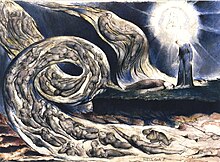
Romanticism was a complex artistic, literary, and intellectual motility that originated in the 2d half of the eighteenth century in Western Europe, and gained strength during and after the Industrial and French Revolutions.[12] It was partly a revolt against the political norms of the Historic period of Enlightenment which rationalised nature, and was embodied well-nigh strongly in the visual arts, music, and literature.[12] Romanticism has been seen as "the revival of the life and thought of the Middle Ages",[thirteen] reaching beyond rational and Classicist models to elevate medievalism and elements of art and narrative perceived to be authentically medieval, in an endeavor to escape the confines of population growth, urban sprawl and industrialism, embracing the exotic, unfamiliar and afar.[13] [fourteen]
The name "Romanticism" itself was derived from the medieval genre chivalric romance. This movement contributed to the strong influence of such romances, disproportionate to their actual showing among medieval literature, on the image of Center Ages, such that a knight, a distressed dryad, and a dragon is used to conjure upwards the time pictorially.[15] The Romantic interest in the medieval tin particularly be seen in the illustrations of English language poet William Blake and the Ossian bike published past Scottish poet James Macpherson in 1762, which inspired both Goethe's Götz von Berlichingen (1773), and the young Walter Scott. The latter's Waverley Novels, including Ivanhoe (1819) and Quentin Durward (1823) helped popularise, and shape views of, the medieval era.[xvi] The same impulse manifested itself in the translation of medieval national epics into modern vernacular languages, including Nibelungenlied (1782) in Frg,[17] The Lay of the Cid (1799) in Spain,[18] Beowulf (1833) in England,[19] The Song of Roland (1837) in France,[20] which were widely read and highly influential on subsequent literary and creative work.[21]
The Nazarenes [edit]

The name Nazarene was adopted by a group of early on nineteenth-century German language Romantic painters who reacted confronting Neoclassicism and hoped to render to art which embodied spiritual values. They sought inspiration in artists of the late Eye Ages and early Renaissance, rejecting what they saw as the superficial virtuosity of later art.[22] The proper name Nazarene came from a term of derision used against them for their arrayal of a biblical mode of wearable and hair way.[22] The movement was originally formed in 1809 by six students at the Vienna Academy and called the Brotherhood of St. Luke or Lukasbund, subsequently the patron saint of medieval artists.[23] In 1810 four of them, Johann Friedrich Overbeck, Franz Pforr, Ludwig Vogel and Johann Konrad Hottinger moved to Rome, where they occupied the abandoned monastery of San Isidoro and were joined past Philipp Veit, Peter von Cornelius, Julius Schnorr von Karolsfeld, Friedrich Wilhelm Schadow and a loose grouping of other High german artists.[22] They met upward with Austrian romantic landscape artist Joseph Anton Koch (1768–1839) who became an unofficial tutor to the group and in 1827 they were joined by Joseph von Führich (1800–76).[22] In Rome the group lived a semi-monastic existence, as a way of re-creating the nature of the medieval artist'south workshop. Religious subjects dominated their output and two major commissions for the Casa Bartholdy (1816–17) (later moved to the Alte Nationalgalerie in Berlin) and the Casino Massimo (1817–29), allowed them to endeavor a revival of the medieval art of fresco painting and gained then international attention.[24] However, by 1830 all except Overbeck had returned to Frg and the grouping had disbanded. Many Nazareners became influential teachers in German art academies and were a major influence on the later English Pre-Raphaelite Brotherhood.[22]
Gothic revival [edit]
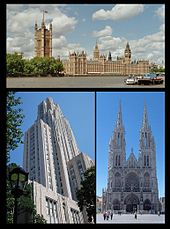
The Gothic Revival was an architectural movement which began in the 1740s in England.[25] Its popularity grew quickly in the early nineteenth century, when increasingly serious and learned admirers of neo-Gothic styles sought to revive medieval forms in contrast to the classical styles prevalent at the time.[26] In England, the epicentre of this revival, it was intertwined with deeply philosophical movements associated with a re-awakening of "High Church" or Anglo-Catholic self-conventionalities (and by the Catholic convert Augustus Welby Pugin) concerned by the growth of religious nonconformism.[25] He went on to produce important Gothic buildings such as Cathedrals at Birmingham and Southwark and the British Houses of Parliament in the 1840s.[27] Big numbers of existing English churches had features such every bit crosses, screens and stained drinking glass (removed at the Reformation), restored or added, and most new Anglican and Catholic churches were congenital in the Gothic style.[28] Viollet-le-Duc was a leading figure in the movement in French republic, restoring the entire walled city of Carcassonne as well every bit Notre-Dame and Sainte Chapelle in Paris.[27] In America Ralph Adams Cram was a leading force in American Gothic, with his near aggressive project the Cathedral of St. John the Divine in New York (1 of the largest cathedrals in the world), as well as Collegiate Gothic buildings at Princeton Graduate College.[27] On a wider level the wooden Carpenter Gothic churches and houses were built in large numbers across North America in this menstruation.[29]
In English language literature, the architectural Gothic Revival and classical Romanticism gave ascent to the Gothic novel, frequently dealing with nighttime themes in human nature against medieval backdrops and with elements of the supernatural.[thirty] Beginning with The Castle of Otranto (1764) by Horace Walpole, 4th Earl of Orford, information technology also included Mary Shelley's Frankenstein (1818) and John Polidori's The Vampyre (1819), which helped found the modern horror genre.[31] This helped create the night romanticism or American Gothic of authors like Edgar Allan Poe in works including "The Autumn of the House of Usher" (1839) and "The Pit and the Pendulum" (1842) and Nathanial Hawthorne in "The Minister's Black Veil" (1836) and "The Birth-Mark" (1843).[32] This in turn influenced American novelists like Herman Melville in works such as Moby Dick (1851).[33] Early on Victorian Gothic novels included Emily Brontë'south Wuthering Heights (1847) and Charlotte Brontë's Jane Eyre (1847).[34] The genre was revived and modernised toward the end of the century with works like Robert Louis Stevenson'due south Strange Case of Dr Jekyll and Mr Hyde (1886), Oscar Wilde's The Picture of Dorian Gray (1890) and Bram Stoker's Dracula (1897).[35]
Tardily nineteenth century [edit]
Romantic nationalism [edit]
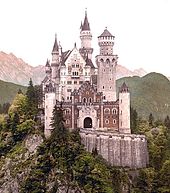
By the belatedly nineteenth century real and pseudo-medieval symbols were a currency of European monarchical state propaganda. German emperors dressed up in and proudly displayed medieval costumes in public, and they rebuilt the great medieval castle and spiritual abode of the Teutonic Order at Marienburg.[36] Ludwig II of Bavaria built a fairy-tale castle at Neuschwanstein and busy information technology with scenes from Wagner's operas, some other major Romantic epitome maker of the Middle Ages.[37] The aforementioned imagery would be used in Nazi Germany in the mid-twentieth century to promote German language national identity with plans for extensive building in the medieval style and attempts to revive the virtues of the Teutonic knights, Charlemagne and the Round Table.[38]
In England, the Centre Ages were trumpeted as the birthplace of democracy because of the Magna Carta of 1215.[39] In the reign of Queen Victoria there was considerable involvement in things medieval, particularly among the ruling classes. The notorious Eglinton Tournament of 1839 attempted to revive the medieval grandeur of the monarchy and elite.[40] Medieval fancy dress became mutual in this period at royal and aristocratic masquerades and balls and individuals and families were painted in medieval costume.[41] These trends inspired a nineteenth-century genre of medieval verse that included Idylls of the Male monarch (1842) by Alfred Tennyson, 1st Baron Tennyson and "The Sword of Kingship" (1866) by Thomas Westwood, which recast specifically modernistic themes in the medieval settings of Arthurian romance.[42] [43]
The Pre-Raphaelites [edit]
The Pre-Raphaelite Brotherhood was a group of English painters, poets, and critics, founded in 1848 by William Holman Hunt, John Everett Millais and Dante Gabriel Rossetti.[44] The iii founders were presently joined past William Michael Rossetti, James Collinson, Frederic George Stephens and Thomas Woolner to form a seven-member "brotherhood".[45] The group's intention was to reform art by rejecting what they considered to be the mechanistic approach first adopted past the Mannerist artists who succeeded Raphael and Michelangelo.[44] They believed that the Classical poses and elegant compositions of Raphael in particular had been a corrupting influence on the bookish pedagogy of fine art. Hence the proper name "Pre-Raphaelite". In item, they objected to the influence of Sir Joshua Reynolds, the founder of the English language Royal Academy of Arts, believing that his broad technique was a sloppy and formulaic form of academic Mannerism. In dissimilarity, they wanted to return to the abundant detail, intense colours, and complex compositions of Quattrocento Italian and Flemish fine art.[46]
The arts and crafts motility [edit]

The arts and crafts movement was an aesthetic movement, directly influenced past the Gothic revival and the Pre-Raphaelites, but moving abroad from aristocratic, nationalist and high Gothic influences to an emphasis on the idealised peasantry and medieval customs, particularly of the fourteenth century, oft with socialist political tendencies and reaching its height betwixt about 1880 and 1910. The movement was inspired past the writings of the critic John Ruskin and spearheaded past the work of William Morris, a friend of the Pre-Raphaelites and a former amateur to Gothic-revival architect Thousand. Eastward. Street. He focused on the fine arts of textiles, wood and metal work and interior design.[47] Morris also produced medieval and ancient themed verse, beside socialist tracts and the medieval Utopia News From Nowhere (1890).[47] Morris formed Morris, Marshall, Faulkner & Co. in 1861, which produced and sold furnishings and piece of furniture, often with medieval themes, to the emerging heart classes.[48] The get-go arts and crafts exhibition in the United States was held in Boston in 1897 and local societies spread across the country, dedicated to preserving and perfecting disappearing craft and beautifying house interiors.[49] Whereas the Gothic revival had tended to emulate ecclesiastical and military compages, the craft movement looked to rustic and vernacular medieval housing.[50] The cosmos of aesthetically pleasing and affordable furnishings proved highly influential on subsequent artistic and architectural developments.[51]
Twentieth and xx-first centuries [edit]
Popular culture [edit]
Historians have attempted to conceptualize the history of not-European countries in terms of medievalisms, merely the approach has been controversial among scholars of Latin America, Africa, and Asia.[52]

Film [edit]
Flick has been 1 of the most significant creators of images of the Centre Ages since the early twentieth century. The get-go medieval movie was also one of the earliest films e'er made, about Jeanne d'Arc in 1899, while the beginning to bargain with Robin Hood dates to as early every bit 1908.[53] Influential European films, often with a nationalist calendar, included the German Nibelungenlied (1924), Eisenstein's Alexander Nevsky (1938) and Bergman's The Seventh Seal (1957), while in France there were many Joan of Arc sequels.[54] Hollywood adopted the medieval every bit a major genre, issuing periodic remakes of the Rex Arthur, William Wallace and Robin Hood stories, adapting to the screen such historical romantic novels every bit Ivanhoe (1952—by MGM), and producing epics in the vein of El Cid (1961).[55] More contempo revivals of these genres include Robin Hood Prince of Thieves (1991), The 13th Warrior (1999) and The Kingdom of Sky (2005).[56]
Fantasy [edit]
While the folklore that fantasy drew on for its magic and monsters was not exclusively medieval, elves, dragons, and unicorns, among many other creatures, were drawn from medieval folklore and romance. Earlier writers in the genre, such equally George MacDonald in The Princess and the Goblin (1872), William Morris in The Well at the Globe'south End (1896) and Lord Dunsany in The King of Elfland'due south Daughter (1924), set their tales in fantasy worlds clearly derived from medieval sources, though often filtered through subsequently views.[57] In the first one-half of the twentieth century lurid fiction writers like Robert E. Howard and Clark Ashton Smith helped popularise the sword and sorcery branch of fantasy, which oftentimes utilised prehistoric and non-European settings beside elements of the medieval.[58] In contrast, authors such as East. R. Eddison and particularly J.R.R. Tolkien, set the blazon for high fantasy, unremarkably based in a pseudo-medieval setting, mixed with elements of medieval folklore.[59] Other fantasy writers have emulated him, and films, role-playing and calculator games also took up this tradition.[60] Modern fantasy writers have taken elements of the medieval from these works to produce some of the most commercially successful works of fiction of recent years, sometimes pointing to the absurdities of the genre, as in Terry Pratchett's Discworld novels, or mixing it with the modern earth as in J. Thou. Rowling'due south Harry Potter books.[61]
Living history [edit]
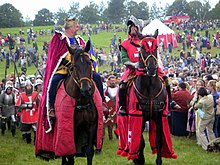

In the 2nd one-half of the twentieth century interest in the medieval was increasingly expressed through class of re-enactment, including combat reenactment, re-creating historical conflict, armour, artillery and skill, besides equally living history which re-creates the social and cultural life of the by, in areas such equally clothing, food and crafts. The movement has led to the creation of medieval markets and Renaissance fairs, from the late 1980s, particularly in Germany and the United States of America.[62]
Neo-medievalism [edit]
Neo-medievalism (or neomedievalism) is a neologism that was showtime popularized by the Italian medievalist Umberto Eco in his 1973 essay "Dreaming of the Middle Ages".[63] The term has no clear definition just has since been used to describe the intersection between pop fantasy and medieval history as can be seen in calculator games such as MMORPGs, films and goggle box, neo-medieval music, and popular literature.[64] Information technology is in this area—the report of the intersection between gimmicky representation and by inspiration(s)—that medievalism and neomedievalism tend to be used interchangeably.[65] Neomedievalism has besides been used as a term describing the postal service-modern report of medieval history[66] and as a term for a trend in modern international relations, outset discussed in 1977 past Hedley Bull, who argued that lodge was moving towards a form of "neomedievalism" in which individual notions of rights and a growing sense of a "world common good" were undermining national sovereignty.[67]
The written report of medievalism [edit]
Leslie J. Workman, Kathleen Verduin and David Metzger noted in their introduction to Studies in Medievalism Ix "Medievalism and the Academy, Vol I" (1997) their sense that medievalism had been perceived past some medievalists as a "poor and somewhat whimsical relation of (presumably more serious) medieval studies".[68] In The Cambridge Companion to Medievalism (2016), editor Louise D'Arcens noted that some of the earliest medievalism scholarship (that is, study of the phenomenon of medievalism) was by Victorian specialists including Alice Chandler (with her monograph A Dream of Order: The Medieval Platonic in Nineteenth Century England (London: Taylor and Francis, 1971), and Florence Boos, with her edited volume History and Customs: Essays in Victorian Medievalism (London: Garland Publishing, 1992)).[two] D'Arcens proposed that the 1970s saw the subject field of medievalism go an academic area of enquiry in its own correct, with the International Club for the Study of Medievalism formalised in 1979 with the publication of its Studies In Medievalism periodical, organised past Leslie J. Workman.[two] D'Arcens notes that by 2016 medievalism was taught as a bailiwick on "hundreds" of university courses around the world, and at that place were "at to the lowest degree ii" scholarly journals defended to medievalism studies: Studies in Medievalism and postmedieval.[two]
Clare Monagle has argued that political medievalism has acquired medieval scholars to repeatedly reconsider whether medievalism is a part of the report of the Middle Ages equally a historical catamenia. Monagle explains how in 1977 the International Relations scholar Hedley Balderdash coined the term "New Medievalism" to describe the globe equally a issue of the rising powers of non-country actors in society (such as terrorist groups, corporations, or supra-state organisations such as the European Economic Community) which, due to new technologies, boundaries of jurisdiction that cross national borders, and shifts in private wealth challenged the exclusive authority of the state.[69] Monagle explained that in 2007 medieval scholar Bruce Holsinger published Neomedievalism, Conservativism and the War on Terror, which identified how George West. Bush'due south administration relied on medievalising rhetoric to identify al-Qaeda as "dangerously fluid, elusive, and stateless".[69] Monagle documents how Gabrielle Spiegel, and then president of the American Historical Lodge "expressed concern at the idea that scholars of the historical medieval period might consider themselves licensed to in some style to intervene in contemporary medievalism", equally to do so "conflates ii very different historical periods".[69] Eileen Joy (co-founder and co-editor of the postmedieval journal),[70] responded to Spiegel that "the idea of a medieval past itself, as something that can exist demarcated and cordoned off from other historical fourth dimension periods, was and is of itself [...] a course of medievalism. Therefore, practising medievalists should admittedly pay heed to the use and abuse of the Middle Ages in contemporary discourse".[69]
Medievalism topics are now annual features at the major medieval conferences the International Medieval Congress hosted at the University of Leeds, UK, and the International Congress on Medieval Studies at Kalamazoo, Michigan.[2]
Exhibitions about medievalism [edit]
- 30 January - 22 May 2013. New Medievalist visions, King's College London, Maughan Library.[71]
- Oct 16, 2018 - March 3, 2019. Juggling the Middle Ages, Dumbarton Oaks, Washington DC. Juggling the Middle Ages "explores the influence of the medieval world by focusing on this unmarried story with a long-lasting touch on", Le Jongleur de Notre Matriarch or Our Lady'south Tumbler. [72] [73] [74]
Notes [edit]
- ^ J. Simpson; E. Weiner, eds. (1989). "Medievalism". Oxford English Dictionary (2d ed.). Oxford: Oxford Academy Press.
- ^ a b c d eastward D'Arcens, Louise (2016-03-02). The Cambridge Companion to Medievalism. Cambridge Academy Printing. pp. 1–10. ISBN978-1-316-54620-8.
- ^ Mommsen, Theodore Eastward. (1942). "Petrarch's Conception of the 'Dark Ages'". Speculum. Cambridge MA: Medieval Academy of America. 17 (2): 226–42. doi:10.2307/2856364. JSTOR 2856364. S2CID 161360211.
- ^ C. Rudolph, A companion to medieval art: Romanesque and Gothic in Northern Europe (Wiley-Blackwell, 2006), p. 4.
- ^ a b Albrow, Martin, The global historic period: country and society beyond modernity (1997), p. 205.
- ^ Random House Dictionary (2010), "Mediaeval"
- ^ F. Oakley, The medieval experience: foundations of Western cultural singularity (University of Toronto Press, 1988), pp. 1-4.
- ^ R. D. Linder, The Reformation Era (Greenwood, 2008), p. 124.
- ^ Yard. J. Christiano, West. H. Swatos and P. Kivisto, Folklore of Religion: Gimmicky Developments (Rowman Altamira, 2002), p. 77.
- ^ a b R. Bartlett, Medieval Panorama (Getty Trust Publications, 2001), p. 12.
- ^ Due south. J. Barnett, The Enlightenment and Religion: the Myths of Modernity (Manchester: Manchester University Printing, 2003), p. 213.
- ^ a b A. Chandler, A Dream of Order: the Medieval Ideal in Nineteenth-Century English language Literature (London: Taylor & Francis, 1971), p. 4.
- ^ a b R. R. Agrawal, "The Medieval Revival and its Influence on the Romantic Move", (Abhinav, 1990), p. ane. ISBN 978-8170172628
- ^ Perpinyà, Núria. Ruins, Nostalgia and Ugliness. V Romantic perceptions of the Centre Ages and a spoonful of Game of Thrones and Avant-garde oddity. Berlin: Logos Verlag. 2014 ISBN 978-3-8325-3794-iv
- ^ C. Southward. Lewis, The Discarded Image (Cambridge: Cambridge University Printing, 1964), ISBN 0-521-47735-2, p. 9.
- ^ A. Chandler, A Dream of Order: the Medieval Ideal in Nineteenth-century English Literature (London: Taylor & Francis, 1971), pp. 54-7.
- ^ W. P. Gerritsen, A. K. Van Melle and T. Guest, A Lexicon of Medieval Heroes: Characters in Medieval Narrative Traditions and Their Afterlife in Literature, Theatre and the Visual Arts (Boydell & Brewer, 2000), p. 256.
- ^ R. Eastward. Chandler and K. Schwart, A New History of Spanish Literature (LSU Press, 2nd edn., 1991), p. 29.
- ^ K. Alexander, Beowulf: a Verse Translation (London: Penguin Classics, 2nd edn., 2004), p. 18.
- ^ K. S. Burgess, The Song of Roland (London: Penguin Classics, 1990), p. 7.
- ^ S. P. Sondrup and G. Due east. P. Gillespie, Nonfictional Romantic Prose: Expanding Borders (John Benjamins, 2004), p. viii.
- ^ a b c d e Thousand. F. Reinhardt, Germany: 2000 years, Volume 2 (Continuum, 1981), p. 491.
- ^ A. Chandler, A Dream of Order: the Medieval Platonic in Nineteenth-Century English language Literature (London: Taylor & Francis, 1971), p. 191.
- ^ Thousand. Curran, The Romanesque Revival: Religion, Politics, and Transnational Exchange (Penn State Press, 2003), p. 4.
- ^ a b N. Yates, Liturgical Space: Christian Worship and Church Buildings in Western Europe 1500-2000 (Aldershot: Ashgate Publishing, 2008), p. 114,
- ^ A. Chandler, A Dream of Society: the Medieval Ideal in Nineteenth-Century English Literature (London: Taylor & Francis, 1971), p. 184.
- ^ a b c M. Moffett, M. Due west. Fazio, Fifty. Wodehouse, A Earth History of Compages (2d edn., Laurence Male monarch, 2003), pp. 429-41.
- ^ K. Alexander, Medievalism: the Middle Ages in Mod England (Yale Academy Printing, 2007), pp. 71-3.
- ^ D. D. Volo, The Antebellum Period American popular civilisation Through History (Greenwood, 2004), p. 131.
- ^ F. Botting, Gothic (CRC Press, 1996), pp. 1-2.
- ^ Due south. T. Joshi, Icons of Horror and the Supernatural: an Encyclopedia of our Worst Nightmares (Greenwood, 2007), p. 250.
- ^ Due south. T. Joshi, Icons of Horror and the Supernatural: an Encyclopedia of our Worst Nightmares, Book 1 (Greenwood, 2007), p. 350.
- ^ A. L. Smith, American Gothic Fiction: an Introduction (Continuum, 2004), p. 79.
- ^ D. David, The Cambridge Companion to the Victorian Novel (Cambridge: Cambridge Academy Press, 2001), p. 186.
- ^ Due south. Arata, Fictions of Loss in the Victorian Fin de Siècle (Cambridge: Cambridge University Press, 1996), p. 111.
- ^ R. A. Etlin, Art, Culture, and Media Under the Third Reich (University of Chicago Printing, 2002), p. 118.
- ^ Lisa Trumbauer, King Ludwig'due south Castle: Germany's Neuschwanstein (Bearport, 2005).
- ^ V. Ortenberg, In Search of the Holy Grail: the Quest for the Middle Ages (Continuum, 2006), p. 114.
- ^ R. Chapman, The Sense of the Past in Victorian Literature (London: Taylor & Francis, 1986), pp. 36-7.
- ^ I. Anstruther, The Knight and the Umbrella: An Business relationship of the Eglinton Tournament - 1839 (London: Geoffrey Bles, 1963), pp. 122-3.
- ^ J. Banham and J. Harris, William Morris and the Middle Ages: a Collection of Essays, together with a Catalogue of Works Exhibited at the Whitworth Fine art Gallery, 28 September-viii December 1984 (Manchester: Manchester Academy Press, 1984), p. 76.
- ^ R. Cronin, A. Chapman and A. H. Harrison, A Companion to Victorian Poetry (Wiley-Blackwell, 2002), p. 247.
- ^ I. Bryden, Reinventing King Arthur: the Arthurian Legends in Victorian Civilisation (Aldershot: Ashgate Publishing, Ltd., 2005), p. 79.
- ^ a b R. Cronin, A. Chapman and A. H. Harrison, A Companion to Victorian Poetry (Wiley-Blackwell, 2002), p. 305.
- ^ J. Rothenstein, An Introduction to English Painting (I.B.Tauris, 2001), p. 115.
- ^ S. Andres, The pre-Raphaelite art of the Victorian novel: narrative challenges to visual gendered boundaries (Ohio Land Academy Press, 2004), p. 247.
- ^ a b F. S. Kleiner, 'Gardner's Art Through the Ages: A Global History (13th edn., Cengage Learning EMEA, 2008), p. 846.
- ^ C. Harvey and J. Press, William Morris: Design and Enterprise in Victorian Britain (Manchester: Manchester University Press, 1991), pp. 77-8.
- ^ D. Shand-Tucci, and R. A. Cram, Boston Bohemia, 1881-1900: Ralph Adams Cram Life and Literature (University of Massachusetts Printing, 1996), p. 174.
- ^ V. B. Canizaro, Architectural Regionalism: Collected Writings on Place, Identity, Modernity, and Tradition (Princeton Architectural Press, 2007), p. 196.
- ^ John F. Pile, A History of Interior Blueprint (2nd edn., Laurence King, 2005), p. 267.
- ^ Kathleen Davis and Nadia Altschul, eds. Medievalisms in the Postcolonial World: The Idea of "the Heart Ages" Exterior Europe (2009)
- ^ T. G. Hahn, Robin Hood in Popular Civilization: Violence, Transgression, and Justice (Boydell & Brewer, 2000), p. 87.
- ^ Norris J. Lacy, A History of Arthurian Scholarship (Boydell & Brewer Ltd, 2006), p. 87.
- ^ Due south. J. Umland, The Use of Arthurian Fable in Hollywood Film: from Connecticut Yankees to Fisher Kings (Greenwood, 1996), p. 105.
- ^ N. Haydock and E. L. Risden, Hollywood in the Holy Land: Essays on Film Depictions of the Crusades and Christian-Muslim Clashes (McFarland, 2009), p. 187.
- ^ R. C. Schlobin, The Aesthetics of Fantasy Literature and Fine art (University of Notre Matriarch Press, 1982), p. 236.
- ^ J. A. Tucker, A Sense of Wonder: Samuel R. Delany, Race, Identity and Difference (Wesleyan Academy Press, 2004), p. 91.
- ^ Jane Yolen, "Introduction", After the Male monarch: Stories in Honor of J. R. R. Tolkien, ed, Martin H. Greenberg, pp. 7-viii. ISBN 0-312-85175-viii.
- ^ D. Mackay, The Fantasy Function-Playing Game: a New Performing Art (McFarland, 2001), ISBN 978-0786450473, p. 27.
- ^ Michael D. C. Drout, J.R.R. Tolkien Encyclopedia: Scholarship and Critical Cess (Taylor & Francis, 2007), ISBN 978-0415969420, p. 380.
- ^ 1000. C. C. Adams, Echoes of War: A Thousand Years of Armed forces History in Popular Civilisation (Academy Press of Kentucky, 2002), p. 2.
- ^ Umberto Eco, "Dreaming of the Middle Ages," in Travels in Hyperreality, transl. by W. Weaver (New York: Harcourt Brace, 1986), pp. 61–72. Eco wrote, "Thus we are at present witnessing, both in Europe and America, a menstruation of renewed interest in the Center Ages, with a curious oscillation between fantastic neomedievalism and responsible philological examination."
- ^ M. Westward. Driver and S. Ray, eds, The medieval hero on screen: representations from Beowulf to Buffy (McFarland, 2004).
- ^ J. Tolmie, "Medievalism and the Fantasy Heroine", Journal of Gender Studies, vol. 15, No. 2 July 2006, pp. 145–58
- ^ Cary John Lenehan."Postmodern Medievalism", Academy of Tasmania, November 1994.
- ^ K. Alderson and A. Hurrell, eds, Hedley Bull on International Society (London: Palgrave Macmillan, 2000), p. 56.
- ^ Workman, Leslie J.; Verduin, Kathleen; Metzger, David; Metzger, David D. (1999). Medievalism and the Academy. Boydell & Brewer. p. two. ISBN978-0-85991-532-8.
- ^ a b c d Monagle, Clare (2014-04-18). "Sovereignty and Neomedievalism". In D'arcens, Louise; Lynch, Andrew (eds.). International Medievalism and Popular Culture. Cambria Press. ISBN978-ane-60497-864-iii.
- ^ "A word from the co-editor of postmedieval, Eileen A. Joy". www.palgrave.com . Retrieved 2020-11-08 .
- ^ "New Medievalist visions Exhibition at the Maughan Library | Website archive | King'southward College London". www.kcl.ac.uk . Retrieved 2020-10-24 .
- ^ Wilson, Lain. "Juggling the Center Ages". Dumbarton Oaks . Retrieved 2020-x-24 .
- ^ Nguyen, Sophia (2018-10-18). "The Juggler's Tale". Harvard Magazine . Retrieved 2020-10-24 .
- ^ Dame, Marketing Communications: Web | Academy of Notre. "D.C. museum tells an quondam Notre Dame story | Stories | Notre Dame Magazine | University of Notre Dame". Notre Dame Magazine . Retrieved 2020-ten-24 .
Source: https://en.wikipedia.org/wiki/Medievalism
0 Response to "what cultural belief gave rise to the idealized"
Post a Comment